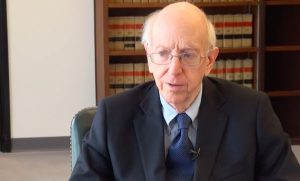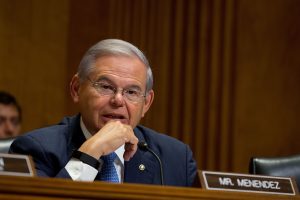
Last summer, we wrote about the stinging benchslap that Judge Loretta Preska (S.D.N.Y.; pictured), the highly regarded Manhattan trial judge, administered to Cleary Gottlieb, the highly regarded Manhattan law firm. Judge Preska sanctioned the firm for what she viewed as the improper attempt by one partner to dissuade a witness from attending a deposition. At the time, Cleary announced its intent to appeal.
It was a matter of honor that brought Cleary Gottlieb Steen & Hamilton to the 2nd U.S. Circuit Court of Appeals Wednesday morning. Several lawyers from the firm, led by managing partner Mark Walker, were present in the ceremonial courtroom of the Daniel Patrick Moynihan U.S. Courthouse.
A matter of honor. Will there be a duel? Guns all around, says SCOTUS.
Well, maybe not a literal duel. But Cleary's counsel, the distinguished Roy Reardon of Simpson Thacher, did mix it up with opposing counsel, Kevin Reed of Quinn Emanuel. As did the Second Circuit panel:
The 2nd Circuit judges asked [Reed] whether Kensington had been unreasonable in insisting that the deposition be held on Feb. 4 in Washington when a Paris deposition seemed a reasonable compromise.
"Everything would grind to a halt if lawyers couldn't accommodate each other," said Judge Miner.
"Everything would grind to a halt if everyone resorted to self-help as Cleary did here," Reed replied. He later added: "You don't go to the witness and say the sort of things [Cleary partner Jean-Pierre] Vignaud said, which can only have the effect of intimidating a witness and shaping his testimony."
So the alleged attempt by Cleary to dissuade a witness from attending a deposition arose out of a familiar dispute over depo location. Perhaps the parties should have taken a page from Judge James Nowlin's playbook, and taken it to midfield. Anyone up for a depo on a north Atlantic cruise ship?
Pity the poor partners of McDermott Will & Emery. Sure, their firm is highly regarded and highly profitable. But when they head off to try cases in far-off places, they often get benchslapped silly.
You may recall the case of bankruptcy partner William Smith, who found himself in the deep-fat fryer after telling a judge she was "a few French Fries short of a Happy Meal." Although the judge was upset, in the end Smith got a slap on the wrist.
Things didn't end as happily for Terrence McMahon and Vera Elson, MWE partners based in Silicon Valley. Judge Richard P. Matsch -- the tough, well-regarded trial judge who presided over the Oklahoma City bombing case -- sanctioned McMahon and Elson for "cavalier and abusive" misconduct and a "what can I get away with?" attitude during trial. From the Denver Post:
A federal judge recently got so infuriated by the conduct of two highly regarded trial attorneys that he overturned a jury's $51 million verdict, then ordered the lawyers to pay the fees and costs of the opposing lawyers, a sum that could total several million dollars.
Ouch. So is that coming out of their partnership draws?
Or maybe the firm will find other ways to cut costs. Read more, after the jump.
Update: Please note that this post has been corrected since it was first published. The correction appears after the jump.
Wednesday, January 30, 2008 4:10 PM - By David Lat
Any trial judge with the Gall to benchslap the Supreme Court has a serious set of cojones.
Accordingly, Judge Richard Kopf (D. Neb.) -- who sent beer to Professor Doug Berman, as recently noted -- is our Judge of the Day. See links collected below.
We agree with Tony Mauro: Judge Kopf's irreverent "top 10" list of lessons learned from the high court's sentencing jurisprudence is "a provocative jaw-dropper that may get Kopf scratched off the holiday card list at the Supreme Court."
Today we bring you not one, but two Judges of the Day. We can't decide who is more deserving of the honor. From the Florida Times-Union:
Twelve days before Christmas, Circuit Judge Aaron Bowden fired his 17-year judicial assistant, who had been on leave since August with cancer. The Jacksonville judge said he feared her prolonged illness would leave him without an assistant at a time when the state had implemented a hiring freeze.
But his decision left Christine Birch, 54, with no medical, life or disability insurance and has created a firestorm at the courthouse.
Chief Circuit Judge Donald Moran responded by calling Bowden "a no-good son of a bitch," prompting Bowden to respond with a blistering e-mail (PDF) defending his decision and calling Moran's criticism irresponsible, unprofessional and unseemly.
Other judges' assistants were also appalled by Birch's firing. They raised money to pay her rent this month....
Birch declined comment Thursday. But she thanked Moran in a handwritten note last week for putting her back on the courthouse payroll in a rotating judicial assistant's position. Birch was paid about $3,275 a month in her old job, and the state paid her health insurance premium. Her new rotating position pays $750 less a month and requires her to pay her own premiums.
Our tipster writes:
Best quote from the article: "He said if she died while on the payroll, he would have been without an assistant for two months, 'not an ideal situation for a judge.'" I guess dying wouldn't have been an ideal situation for her, either.
To get both sides of the story, check out the email from Judge Bowden in which he defends his actions (and rips Chief Judge Moran a new one). You can access his message -- in which he benchslaps Chief Judge Moran for his "effrontery" and his "irresponsible" comments, made "precipitously [and] without authority" -- by clicking here (PDF).
P.S. Speaking of cancer, here's a PSA from ATL, and bad news for Biglaw associates and paralegals: according to cancer researchers, overnight work and sleep deprivation may raise your cancer risk.
As the old adage goes, "A lawyer who represents himself has a fool for a client." And there is some anecdotal evidence in support of that proposition. See, e.g., Elana Glatt / Elana Elbogen (depending upon how you view the merits of her case against her wedding florist).
Here's another example of what can happen when Biglaw litigators represent themselves. From TaxProf Blog:
The Tax Court today decided Hynes v. Commissioner, T.C. Summ. Op. 2008-1 (1/2/08), a case involving Shawn T. Hynes, a fifth year securities litigation associate in Cleary Gottlieb's New York City office. The taxable year at issue was 2003, when Hynes was a Penn 3L (he tranferred to Penn after completing his first year at Oregon).
More about the facts of Shawn Hynes's case, and how he got benchslapped by the Tax Court, after the jump.
(We realize this is old news, but we're declaring this Remedial Blogging Day at ATL. We have a few other slightly stale stories that we may write up later today, if it continues to be a slow news day.)
Judge Harold Baer (S.D.N.Y.) was once nominated as a hottie of the federal judiciary. Alas, he didn't win.
But in a competition for hotheadedness rather than hotness, Judge Baer might fare better. From a very interesting article by Anthony Lin in the New York Law Journal:
A Manhattan federal judge has delivered a lengthy manifesto against declining civility in the legal profession in the course of sanctioning law firm Dorsey & Whitney and two of its partners.
Southern District of New York Judge Harold Baer opened his 129-page decision with a discussion of how "naked competition and singular economic focus of the marketplace have begun to infiltrate the practice of law, subordinating the high standards of service, collegiality and professionalism as a result."
He ended it with his observation that "partners are at times made and retained for their rainmaking skills and not for their legal skill, that the number of billable hours is not only the alpha and omega of bonuses but that these hours -- or at least the ones that count -- often exclude pro bono hours, or that who gets credit for originating a piece of business can throw a firm into turmoil and prompt internecine struggles, or that the bottom line has eclipsed most everything else for which the practice of law stands or stood to the extent that the practice of law is now frequently described as a business rather than a profession."
Usually when a federal judge tears you a new one, you just grin and bear it. Or maybe go out and buy some Preparation H.
But the lawyer who was the subject of Judge Baer's ire actually struck back. Read more, after the jump.
While you wait for more bonus announcements to trickle in, check out a benchslap from the nation's capital. The Washington Examiner reports:
Furious over the city’s “stunning ignorance” of the crisis facing its special-education system, a federal judge has given the District of Columbia one week to come up with a cost-fixing schedule — or face contempt charges.
In an unusually caustic order, U.S. District Judge Paul L. Friedman has ordered State Superintendent Deborah L. Gist and schools Chancellor Michelle Rhee to come up with a policy for setting rates with the thousands of private schools and vendors with which it does business.
Judge Friedman had especially harsh words for the city's counsel:
“The defendants’ response demonstrates a stunning ignorance of the history of [the] litigation and the operative orders issued by this court,” the judge wrote. “The only plausible explanation is that the attorneys whose names appear on the signature page ... must not have read it. ...”
Lighten up, Your Honor. Lots of people sign stuff they didn't draft, or even read. They're called partners.
This short video clip requires little introduction. Res ipsa loquitur. Just watch Judge Marilyn Milian, of The People's Court, benchslap a cute-but-insolent 2L from the University of Miami:
Last week we honored Judge Samuel B. Kent with our prestigious Judge of the Day award, based on his alleged sexual harassment of a court employee. Now the Fifth Circuit Judicial Council has also recognized Judge Kent. From Texas Lawyer:
The Judicial Council of the 5th U.S. Circuit Court of Appeals [on Friday] issued an order reprimanding and admonishing U.S. District Judge Samuel B. Kent of Galveston. The order relates to a complaint of judicial misconduct lodged against the judge on May 21 alleging sexual harassment toward an employee of the federal judicial system.
A former case manager for Kent, Cathy McBroom, confirms she filed a complaint against the judge. She declines further comment. McBroom currently works in the clerk's office in the Houston Division of the Southern District of Texas.
You can access the order here (PDF). But as a tipster notes, "All the juicy stuff will 'not be disclosed.' No fun at all."
Fear not, judicial gossip aficionados. The Houston Chronicle has more details:
Kent is accused of harassing and inappropriately touching his 49-year-old case manager in his chambers in March....
On the day of the incident, other employees saw McBroom crying and visibly upset, according to interviews. A few weeks later, McBroom transferred to another federal court job in Houston. McBroom was so shaken by the encounter, "She (was) a basket case," an acquaintance said.
McBroom has retained Houston attorney Rusty Hardin, who would not comment for now on the particulars of the case.
Not good news for Judge Kent. Hardin is one of Houston's top trial lawyers.
And this is just the tip of the proverbial iceberg. Additional allegations against Judge Kent, after the jump.
That gurgling sound you hear could be Jack Thompson’s legal career swirling down the ‘loo.
The frequent video game critic, already facing professional misconduct charges from the Florida Bar which could see him stripped of his license to practice law, has outraged a U.S. District Court judge by including images of men having sex in a document filed with the court last week.
What was he thinking? And no, the gay porn was not essential to the case (as it might have been in, say, an obscenity prosecution arising out of said porn).
More details -- if you want them -- after the jump.
Wednesday, September 12, 2007 12:00 PM - By David Lat
Remember Judge Herman Thomas, the Alabama state court judge who allegedly spanked a number of prisoners? Now there's a theme song for the scandal, entitled "Spank Me." Check it out here.
The creator and artist, Jolene Roxbury, is a former paralegal who decided several years ago that comedy was her true calling. You can learn more about her over at her website. Nice work, Jolene!
Wednesday, September 5, 2007 2:00 PM - By David Lat
Mobile County Circuit Judge Herman Thomas is ATL's Judge of the Day. He takes the prize for his innovative approach to sentencing. From the Mobile Press-Register:
Authorities are investigating allegations that now-suspended Mobile County Circuit Judge Herman Thomas periodically removed prisoners from Mobile County Metro Jail and spanked them in a room at the courthouse, according to courthouse sources involved in the inquiry.
Once inside the room, according to the sources, the judge would ask the young men to drop their pants and prepare to be spanked with what they described as a wooden or fraternity-like paddle.
To quote ex-inmate Paris Hilton, "That's hot." We agree with these commenters:
"[I]n San Francisco we have lots of people who pay $200 a session for that kind of treatment. Perhaps this judge has a bright future in Bay Area."
"That's some kinky place. I think Senator Larry Craig would like to break INTO that prison!"
More details -- including a description of the secret six-by-eight room that allegedly served as the judge's S-and-M dungeon -- are available here.
What's up with all these federal judges seeking to leave their life-tenured quarters? We understand that the pay's not great (which is why we urge them to marry rich). But being an Article III judge is still nice work if you can get it.
Despite the power and prestige, two federal judges are moving on -- temporarily or permanently. First, from the Daily Business Review:
In a highly unusual move, U.S. District Judge Martin Jenkins [N.D. Cal. (at right)], a life-tenured federal judge in San Francisco, is prepared to give up his seat and has applied for an opening on the California State Court of Appeal bench.
Jenkins, 54, a moderate Democrat and former state trial court judge in Oakland, Calif., was appointed by President Clinton a decade ago. He confirmed rumors that he has submitted an application with Republican Gov. Arnold Schwarzenegger for the vacancy.
We understand the allure of an appellate over a trial court gig. But still, giving up the federal bench for a state court is "highly unusual" -- especially since the state court in question isn't even the California Supreme Court (the move that Judge Morrison England (E.D. Cal.) was contemplating, before he withdrew his name from consideration).
U.S. District Judge Sam Kent [S.D. Tex.] will take a four-month leave from his Galveston bench for unspecified reasons, according to an order made public Monday.
No one involved would comment on the order, but students of the federal judiciary said it is unusual.
We smell a story here. A little more about Judge Kent, after the jump.
Judge Loretta K. Preska (S.D.N.Y.) has it all: a lifetime appointment to the federal bench, a rich husband, and killer shoes.
As well as, it appears, no patience for lawyers who play fast and loose with the rules. From the WSJ Law Blog:
Cleary Gottlieb conjures images of Ivy League bookishness and international savoir faire, not bare-knuckled litigation tactics. But last week a federal judge sanctioned the firm and found them to have acted in bad faith. “Civil litigation is not always civil,” began a ruling by Loretta Preska, a federal judge in Manhattan. Here’s the opinion (PDF).
The judge concluded that Cleary tried to dissuade a witness from attending a deposition, in part because of a concern the witness would testify adverse to the firm’s client. Preska ordered Cleary to pay the plaintiff’s attorneys fees and costs ─ an amount to be determined ─ and ruled that “the sanction is imposed as a formal reprimand and should be circulated to all attorneys at Cleary.”
And Cleary partner Jean-Pierre Vignaud was ordered to write "I will not interfere improperly with the discovery process," five hundred times, on a dry-erase board in a firm conference room.
Cleary Gottlieb -- which, by the way, picked fellow white-shoe law firm Simpson Thacher to represent it -- said in a statement that it intends to appeal.
We briefly mentioned that Carol Lam, one of the controversial U.S. Attorney firing victims, is now the interim general counsel of Qualcomm. If you'd like to know about the scandal that caused her predecessor, Lou Lupin, to resign, check out the WSJ Law Blog:
It’s something no lawyer wants to get — a ruling from a federal magistrate saying, essentially: “come on down to court and explain to us why you don’t think you should be sanctioned for your behavior.” But that’s what lawyers at Day Casebeer Madrid & Batchelder, based in Cupertino, Calif., received earlier this week from San Diego federal magistrate Barbara Major.
The ruling was essentially a follow-up to a separate ruling made last week by San Diego federal judge Rudi Brewster. Judge Brewster held that wireless giant Qualcomm and its trial counsel, which included lawyers from Day Casebeer, committed “gross litigation misconduct” by withholding crucial evidence in a patent dispute brought by Broadcom. He ordered Qualcomm to pay legal fees to Broadcom, which could amount to $10 million.
Maybe the judge was biased against a firm whose name is a little too close for comfort to "case of beer."
Actually, this is a two-for-one. We can also get a Benchslap of the Day out of this item. From the Miami Herald:
Prominent attorney Hank Adorno -- already under Florida Bar investigation for his role in Miami's fire-fee scandal -- on Wednesday was blasted by the Third District Court of Appeal for what the judges called his ''reprehensible conduct'' in the now infamous case.
In a unanimous opinion that upheld a lower-court decision invalidating Miami's $7 million fire-fee settlement with just seven people, the appeals court ripped into Adorno, who had represented the so-called ''lucky seven.'' The Adorno & Yoss firm stood to earn a $2 million share of the $7 million payout, while some 80,000 taxpayers got nothing.
Huh? How did that almost come to pass?
More discussion, plus the benchslap-worthy language from the court's opinion, after the jump.
Not allowing the defendant to allocute before pronouncing sentence is a rookie mistake for a judge to make. So if a judge makes it, despite having been on the bench for over 25 years, he can expect to get benchslapped. From a Wisconsin reader:
Not sure if this is quite up your alley, but Federal District Judge John Shabaz got bench-slapped pretty hard by the Seventh Circuit in an opinion that came down today.
He's like a million years old and is best known around here for falling asleep during trials and objecting himself and sustaining his own objections. We've decided not to get really worried until he starts overruling himself.
Well, as long as a former clerk doesn't write a tell-all memoir, Judge Shabaz should be just fine.
Chief Judge Dennis Jacobs of the Second Circuit Court of Appeals engages in some impressive benchslappery in a dissent released today. He's not attacking the court's majority opinion, just ignoring it:
I concede that this short opinion of mine does not consider or take into account the majority opinion. So I should disclose at the outset that I have not read it.
Ouch! (We take particular pleasure in pointing out that the majority opinion is by Judge Guido Calabresi, LEWW's favorite elfin jurist.)
Click below to read more about the case, plus more from Judge Jacobs' delightfully disdainful dissent.
Late last week, Bill Mears of CNN wrote a helpful round-up of the best benchslaps from the Supreme Court's most recent Term. It starts off:
One Supreme Court justice says his fellow conservatives are "too dismissive" of government efforts to ensure racial diversity in schools. Another more liberal member says those on the right did "serious violence" to a high school student's free speech rights. And one conservative slams another for "faux judicial restraint."
That last bench-slap was one of several delivered by Justice Scalia to Chief Justice Roberts. For more, see this Linda Greenhouse piece.
But after all the verbal roughhousing, the justices go back to being friends. Then they scamper off to a bevy of European countries, where they spend the summer soaking up adulation and cash teaching summer courses in constitutional law.
The members of the SCOTUS regularly complain about the inadequacy of federal judicial pay. But let's not forget that they -- as well as certain other federal judges, like the members of the D.C. Circuit -- basically get summers off.
Being a Supreme Court justice: Nice work if you can get it!